
Labyrinth Pilgrimage
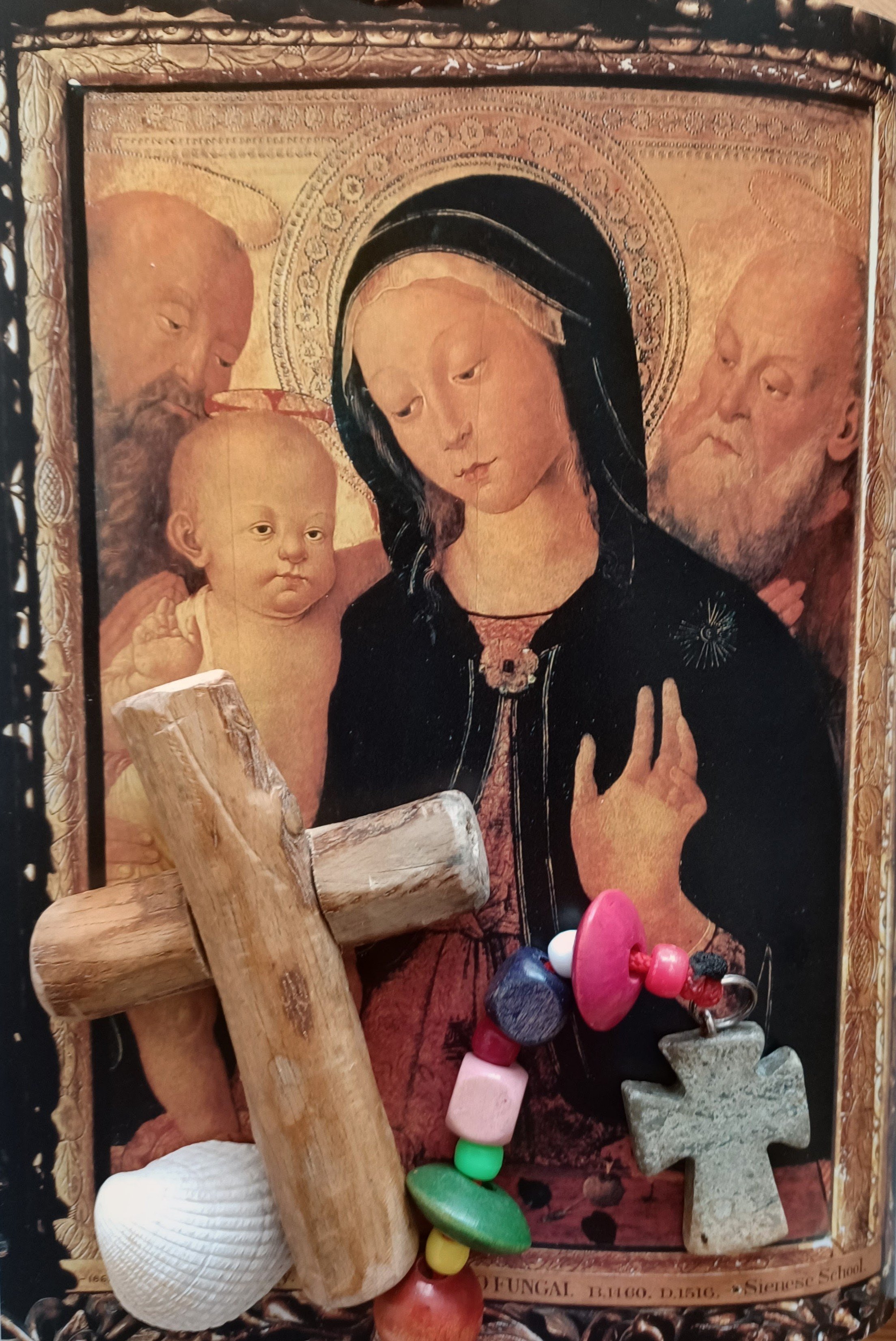
Within the New Testament of the Bible, there are no explicit references to using physical aids to prayer. Nevertheless, as the church has evolved over the centuries, many Christian believers have benefited from using something tangible to aid their devotions.
Examples include the use of crucifixes, icons, rosary beads and music as well as seeking out a specific location. Provided these things are not mistaken for the reality itself, they can be very powerful in helping create a prayerful focus, especially if we are struggling with unhelpful distractions. A labyrinth is one such tool.
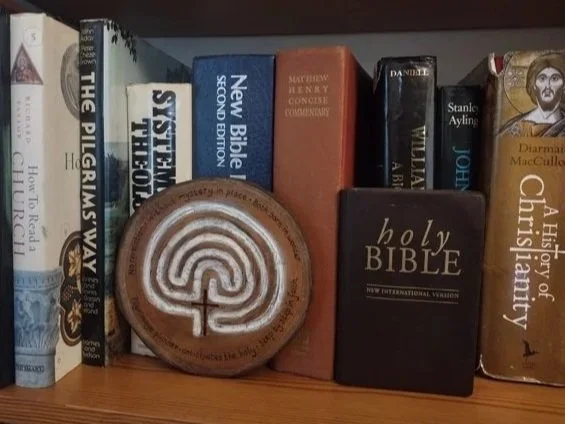
The definition of a labyrinth varies, particularly when trying to differentiate it from the related concept of a maze. However, for our purposes, a labyrinth will be understood as a pattern with a single winding path leading to a centre point.
Within this very simple definition there are multiple design options. They can vary from the very simple to the ingenuously convoluted, as well as being of different sizes. Some can be held in the palm of the hand and are known as a ‘finger’ or ‘hand-held’ labyrinth. These have the advantage of being small and portable while still enabling us to use our imaginations to make journeys that might otherwise be impractical.
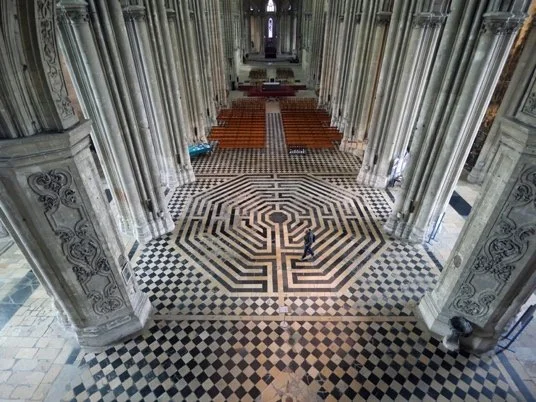
Other, larger examples are large enough to walk through, perhaps in a cathedral as shown in the photo of the Basilica of Saint-Quentin, or in a public place such as a park.
This article focuses on finger labyrinths as the larger types are not readily accessible. However, if you to have an opportunity to visit a large labyrinth, the principals for use described below are equally applicable.
Whichever it proves to be, a labyrinth becomes a ‘prayer labyrinth’ when it is intentionally used as a focus for spiritual practices such as prayer and meditation through the Bible.

Seek, and ye shall find - Matthew 7.7
Draw near to God, and He will draw near to you - James4.8
In this pilgrimage, our journey is followed by tracing the path in a finger labyrinth with a pointing finger. It is rather like following the word in a sentence when learning to read: as the finger moves along the page, the reader's understanding grows, taking them deeper into the significance of the words.
A similar process is used with a finger labyrinth, using touch to maintain focus. It can facilitate concentration during the journey, potentially taking us to a more profound understanding of what God may be saying to us.
The pilgrim journey described below uses the Four Steps of Pilgrimage described on this page.
1. Holy Longing
“Examine yourselves”, 2 Corinthians 13.5
Your pilgrim journey begins with new thoughts or experiences that are in some way challenging, or a desire to examine a specific Scripture.
For this step, keep in mind that this form of pilgrimage can be particularly useful for focusing on a relatively short verse of scripture. Starting from its wider context, it can be a phrase that has been drawn to you attention that could be repeated and reflected upon throughout the journey.
For example:
Peace I leave with you; my peace I give to you - John 14.27
I am with you always, even to the end of the age - Matthew 28.20
I can do all things through Christ who strengthens me - Philippians 4.13
Pray without ceasing - 1 Thessalonians 5.17
Do everything in love - 1 Corinthians 16.14
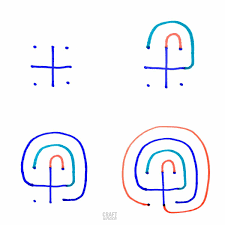
For the journey, it is necessary to either find a labyrinth or to create one. The pictures show how to create a simple labyrinth.
You could draw it, following the steps illustrated, or you could create the same pattern by laying out stones or shells on a suitable surface.

You can also download a PDF file containing pictures of labyrinths by clicking on this link. The PDF file contains four pictures of labyrinths; the final one is a processional labyrinth, see below for more details.
There are also downloadable pictures on the Internet that can be printed.
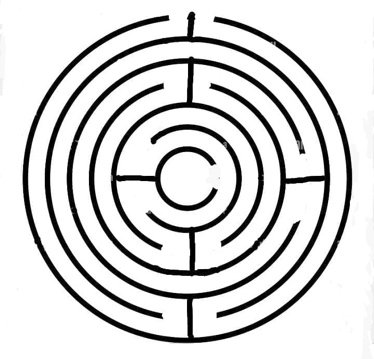
The traditional layout requires the walker to turn around at the centre and then follow the same route out again. However, another type is called a processional labyrinth which have two entrances, as illustrated. Whichever entrance you choose, you will exit via the other. This heightens the sense of being on a continuous journey, as the inward journey is not retraced. It doesn’t matter which entrance you choose but, at some point, it may be of interest to repeat the journey and meditation but this time entering via the other entrance.
When you are prepared, you are ready for the next Step.
2. Pilgrim Journey
“Set your heart on pilgrimage”, Psalm 84.5
During your journey, mediate on the Bible verses you are reading as you review and reflect on your thoughts and experiences.
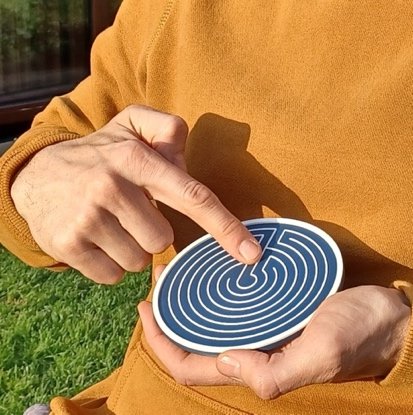
You may make your pilgrim journey in the following manner:
Start at the entrance to the labyrinth and begin tracing the path towards the centre with a finger. Unlike a maze, there is only one path. To get to the centre, the pilgrim only needs to keep moving forward, in trust and obedience.
Rhythmically, start repeating your chosen verse of scripture. You may find it helpful to synchronise this with your breathing.
Use the pressure of your finger on the labyrinth to stay focused throughout the meditation.
Do not race your finger or your thoughts towards the centre. Periodically, stop and pray and reflect; keep the meditation verses in mind so that, as you progress towards the centre, you are entering more deeply into an understanding of the words.
Do not turn around before you get to the centre.
If it is an option for you, you may find it interesting to trace the path with a finger from your non-dominant hand. Changing your finger choice uses a different part of your brain, potentially helping you see things from a new perspective.
There is no recommended duration for this exercise. You may need to repeat it, to fully enter into all that it has to offer you.
3. Prayerful Arrival
“Be transformed by the renewing of your mind”, Romans 12.2
Your reflections during the journey become formulated into definite thoughts and prayers, forming new ideas or modifying existing concepts.
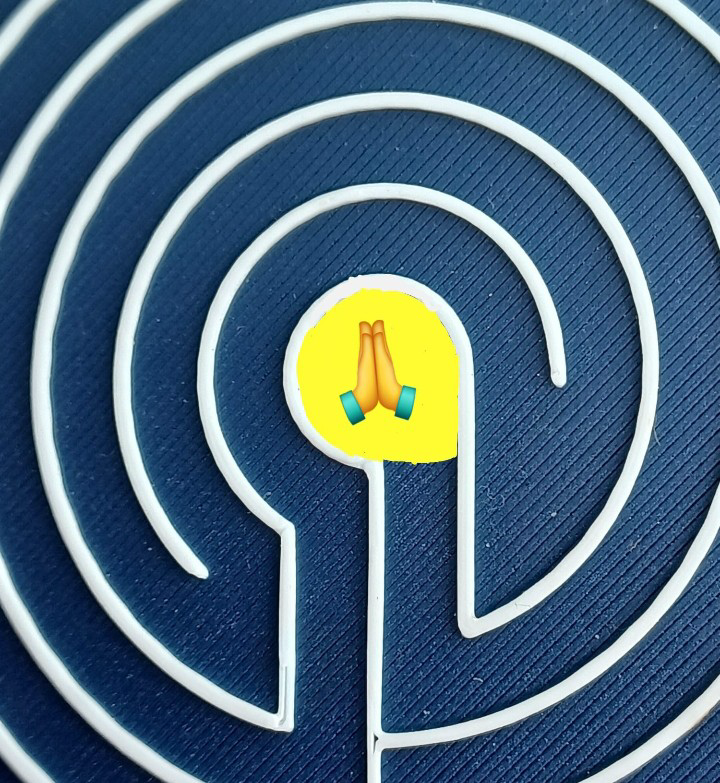
Christians believe the Holy Spirit is dwelling within them. Sometimes, in the busyness of life, we may not be quite so aware of that. So, by deliberately and meditatively arriving at the centre of the labyrinth, we be reminded of this truth.
At the centre, spend time dwelling and resting in the presence of God. Speak to God about your recent journey, reflecting back what you have discovered during your meditation.
4. Servant Response
”Love one another”, John 13.34
Prompted by what you have learnt on your journey, commit to appropriate areas of service in God’s Kingdom.

A vital part of the pilgrim journey is the return. Make a slow, reflective, return back to where you entered the labyrinth.
When you were journeying inwards, you were seeking for a deeper God-given understanding for yourself. Now as you journey outwards, think about how you can share what you have learnt with your community.
It may be helpful to discuss your thoughts with other people, to help test the legitimacy of what you have been hearing.
If you would like more information about this pilgrimage, or anything else, please email me at davidborrowdale54@hotmail.com
I look forward to hearing from you!
